
By Kylie Howard, Editors Victoria Events Officer
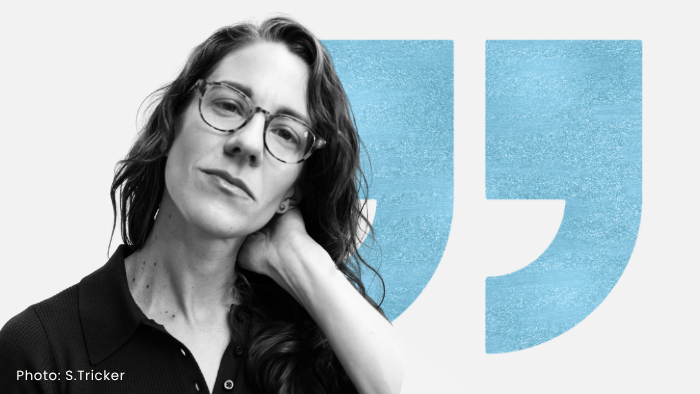
Jessie Kindig is, among other things, a senior editor at Yale University Press, a contributing editor for the feminist magazine Lux and the editor of the Verso book of feminism. Jessie was visiting Australia earlier this month as a guest of the Melbourne Writers Festival. Despite her jam-packed schedule, she was able to join us on 12 May to speak about editing as a feminist and what exactly that means.
Jessie started by talking about the definition of feminism, or rather, its many definitions. She then asked the question, “What does this mean for editing?” She noted that you don’t have to be a feminist to be a good editor – “but it helps”. She spoke about the romantic American “vision” of an editor, the likes of Max Perkins who edited works by F Scott Fitzgerald and other prominent authors of the time. Those editors were more like co-authors, sometimes almost rewriting entire books.
Jessie finds this contrary to what the role of editing should be: guiding the author to make the “best version of the book they can”. She quoted Robert Gottlieb (who, she noted, was definitely not a feminist, but an excellent editor), who said, “A book is never your own, even if you are in the guts of it.”
Jessie believes there are 3 kinds of “work” that set the feminist editor apart from a good, ethical, “humanist” editor.
The first kind of work of a feminist editor is pointing out to authors certain dynamics they might not have seen or thought of. She gave the example of a client who was writing a nonfiction work featuring a protagonist who, apart from being a writer and many other things, treated his wife very poorly. Jessie said this ran throughout the book, but the author hadn’t identified it as a theme. She asked the author to consider that and he took her advice. Ultimately, it was up to the author – it wasn’t about forcing him to deal with things in a certain way – but she was able to point out what she saw.
The second kind of work of a feminist editor is if you’re in a position of power, harness it. For example, if you’re at a publishing house, this might mean making space for feminist works and exploring works with feminist themes. And probably the most important part of this work is championing feminist writing to your colleagues.
Finally, the third kind is to build new institutions out of existing ones. Jessie gave the example of The Sisterhood – founded in the late 1970s by a group of Black American authors and editors. This was a publishing working group that promoted Black women authors. It led to a “renaissance” of Black American women writers in the 1980s, the likes of Alice Walker, Toni Morrison and others, and precipitated a change in what was published in America and what was taught in the US educational system. (Jessie did note that, sadly, some of these advances have recently been axed by or due to the current administration in the US.)
Jessie was asked whether she feels like she is creating an archive of her work. She replied, “Yes absolutely”, but that her loyalty is with authors. She described it as an “archive of a sensibility”, not of herself.
Jessie was a delightful and engaging guest. She was clearly enjoying her time in Melbourne and said it was a joy to be in a country with such a vibrant literary culture. If you missed Jessie’s valuable presentation, the recording will be available to purchase via the IPEd website shortly.