
By Deborah Shaw AE, President
Kia ora
Thank you to everyone who attended the Editors ANZ annual branch meeting in September. It was my final ABM as branch president, and I want to thank you for your support over these last few years. I’d also like to thank Rina Wongpanich and Juanita Nieuwoudt who both stepped down from the EdANZ committee at the ABM. I’ve really enjoyed working with Rina and Juanita and appreciate all their work wrangling our meetings and managing the EdANZ Facebook group. We will miss you!
Thanks too to Joan Gladwyn and Helen Bradford AE for staying on the committee for another year. I look forward to working with you both in my new committee role of branch secretary. Finally, I’m so pleased to welcome Andrea McKay AE to the committee. Andrea is taking over the president role and I’m really looking forward to seeing what direction she’ll take.
Events-wise, we have run 2 editions of Debra Bradley’s workshop – AI for the modern-day editor. Both editions sold out! At the workshop, I appreciated how Debra addressed many attendees’ concerns about how our roles are being affected by generative AI. I also found her risk matrix is a great way to approach how and when I may use AI in my editing. I came away from the workshop knowing there’s still a place for editors, whether or not we want to introduce aspects of AI into our workflows.
This month we have a fantastic article to read by Dr Lawrence Patchett AE. Lawrence writes about his work editing Ryan Bodman’s Rugby league in New Zealand: a people’s history. I heard Ryan speak about his book at the Dunedin Writers & Readers Festival in 2025, and his passion for rugby league and its community drew me in to a sport I didn’t know much about. I found out by chance that Lawrence had edited the book, so I’m very pleased he took me and Helen up on our request for an article. It’s great to get a behind-the-scenes look at how Lawrence approaches his edit.
Once again, thank you for your continued support.
Deborah
Keep in touch with EdANZ through our Facebook page
Introducing Andrea McKay AE
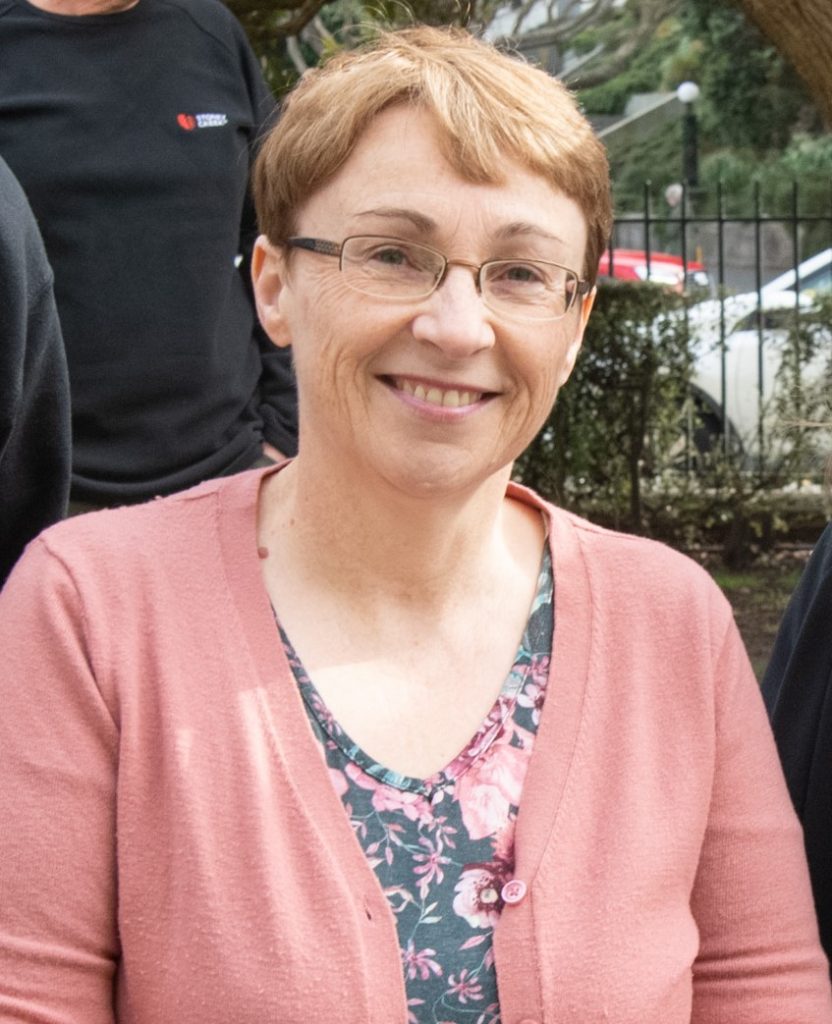
Kia ora koutou
I’m Andrea, and I’m the in-house senior editor in the Brand and Creative team at Te Herenga Waka–Victoria University of Wellington. I edit and project manage all the major publications at the university, mostly student recruitment material and marketing campaigns but also everything from annual reports and event programmes to flyers and merchandise.
I started out as a newspaper reporter and then worked as a sub-editor and duty editor at the New Zealand Press Association, our national news agency. After having my 2 children, I picked up some proofreading work from a former colleague who’d started her own communications business, and then I sold children’s books – I bought more than I sold – and worked in comms part time.
In 2010, I started working remotely for an independent publishing house based in Sydney and Dallas, where I was a copyeditor and proofreader and formatted e-book galleys. When the business folded 5 years later, I started my own freelance business to continue working with some of those authors as they self-published. I’ve edited more than 200 published novels, mostly romances, by authors from all over the world, including 3 books that were later bought by Random House for millions and turned into films (if only some of that money had come my way!).
I have been working at the university since 2020, joined IPEd in 2021 and gained accreditation in 2024. When I’m not reading for work, I read for pleasure and I knit to relax. In other words, my hobbies are hoarding both books and wool.
I’m honoured to be taking over the reins from Deborah, who has been a wonderful branch president for the past 3 years. I’d like to acknowledge her hard work (always done with a big smile) and express my gratitude that she will be staying on the committee. I’ll be relying on her a lot! Thanks also to the rest of the committee for their warm welcome. I’m grateful for their collective knowledge and hope that together we can be strong advocates for New Zealand editors.
I’m keen to hear your views, so feel free to email me at edanz.president@iped-editors.org. I’ll be in touch again next month once I’ve found my feet.
Noho ora mai,
Andrea.
Event report: To AI or not to AI … is that the question?
By Juanita Nieuwoudt, Editors Aotearoa New Zealand
In August and September, New Zealand editor Debra Bradley (Writing for Councils) presented her interactive workshop “AI for the modern-day editor” for IPEd members. In the workshop, Debra helped editors explore how they can use AI to support their work and add value to their services.
A wide range of members attended the workshops. They included editors who edit fiction, nonfiction, business and government publications; technical writers, and an editor who teaches editing. Participants also had varied experience with AI, ranging from experienced users to those who had just begun experimenting with it. The workshop was designed to accommodate this range of experience.
Debra gave us a comprehensive, well-written workbook, which provided the framework for the workshop. The first part of the workshop focused on prompting. It introduced a structured approach to developing prompts for different stages of the editing, from early reader feedback and structural editing through to copyediting and polishing. The workshop participants tested curated prompts on sample documents, using their choice of AI tool. Afterwards, we compared and evaluated the feedback we generated from the AI.
Rather than treating the supplied prompts as a fixed resource, Debra encouraged editors to adapt them to their own work and gradually build a customised prompt library.
An important theme that emerged from the discussions was distinguishing between tasks that AI can assist with and tasks that will continue to depend on editorial judgement. Debra gave us a guided reflection exercise – conducted through an AI interview – that encouraged us to consider what AI can take off our plate, where our own expertise remains essential and how AI could enable us to offer more value to our clients.
The second part of the workshop focused on AI policy. Debra provided a detailed policy framework that participants could adapt for their own businesses and client work. It covers purpose and scope; low-, medium- and high-risk uses of AI; approved tools; responsibility for advice; and monitoring and compliance. Having a clear policy can provide a practical starting point for talking with clients about acceptable AI use.
The workshop was practical, hands-on and thought-provoking. The lively discussion also demonstrated that AI remains a challenging subject for many editors. It feeds into many aspects of running a freelance editing business and raises questions about fear and uncertainty, ethics, professional values and the future of editorial work. These are not always easy conversations. However, participants agreed that workshops of this kind provide a valuable opportunity to move beyond the broader debate and explore, through practical examples, where AI might – and might not – fit into professional editorial practice.
Debra brings a practical understanding of the challenges facing those who work independently and has developed training and resources to share her knowledge with others. If you are interested in finding out about her work and the training she offers, go to her Writing for Councils website.